Do Shade Structures Protect Cars From Hail?
Texas Hail Puts Dealership Inventory at Constant Risk
Texas records more hail events than any other state, and the corridor running from the Panhandle through Dallas-Fort Worth into Central Texas takes the worst of it. The National Weather Service classifies a thunderstorm as severe once hail reaches one inch in diameter, and storms at that threshold roll through the I-35 corridor every spring.
The insurance numbers tell the story in dollars. Texas led the nation in hail events again in recent seasons, and national carriers have paid out billions in hail claims in single years, with Texas consistently at the top of the state rankings.
A dealership feels this exposure differently than a homeowner does. A hail event that dents one commuter car in a driveway can dent two hundred units on an open lot in the same ten minutes. Every dent means paid dent repair, a disclosure conversation, or a wholesale loss. Every damaged unit also sits out of the sales cycle while it waits for repair.
The season runs long. Hail activity in Central Texas concentrates from March through June, then flares again in fall. An unprotected lot spends most of the year one storm cell away from a six-figure claim, and insurance premiums on open inventory reflect that math.
Tensioned Fabric Absorbs Hail Impact Before It Reaches the Paint
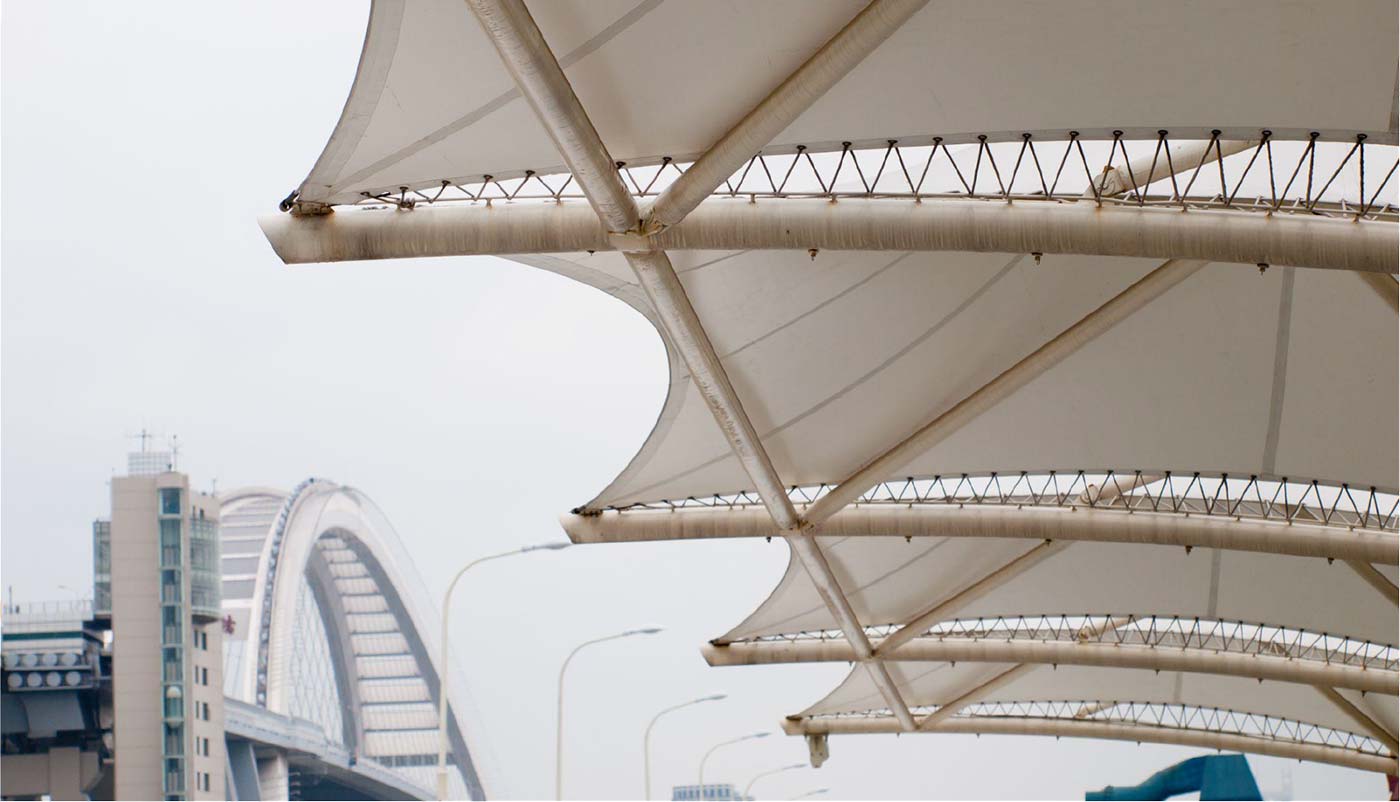
A shade canopy protects vehicles through physics rather than bulk. Commercial fabric stretched under high tension behaves like a trampoline in reverse. A falling hailstone hits the membrane, the fabric flexes, and the impact energy spreads across the panel instead of concentrating on a hood or windshield. Most stones bounce off or roll to the perimeter.
Smaller hail carries less force than most people assume. Stones under one inch fall at roughly 9 to 25 mph, and even severe-threshold stones in the one-inch range arrive between 25 and 40 mph. Tensioned commercial fabric handles those impacts as routine weather.
The honest limit sits at the top of the scale. Supercell storms occasionally produce stones two inches and larger, and hail that size can stress any fabric system. A canopy dramatically reduces damage in those events, but no overhead fabric earns the word hailproof. Dealerships in the most severe corridors treat a canopy as their primary defense and keep insurance in place for outlier storms.
The frame matters as much as the membrane. Fabric only holds tension when the steel holding it refuses to move, which is why the structures worth buying pair the fabric with powder-coated steel engineered to a 90 mph wind rating. As a working bonus, the same Commercial95 fabric blocks up to 95% of UV rays, so the canopy that stops spring hail also stops the summer sun that fades paint and cracks dashboards.
Temporary Covers Fall Short on a Full Lot
The search data around hail protection is full of per-vehicle products: padded car covers, hail blankets for trucks, and inflatable hail protectors. Those tools have a real place for a single prized vehicle in a home driveway. On a commercial lot, the math breaks down fast.
Consider the timeline. Hail warnings often give 15 to 30 minutes of usable notice. Covering one car with a padded cover takes several minutes when done carefully. Multiply that across a 200-unit lot and the storm arrives long before the fourth row is covered, usually with staff still outside in the weather trying to finish.
Cost per vehicle looks small until it scales. Quality padded covers run into hundreds of dollars each, wear out under Texas UV, and spend most of the year in storage. Garages solve the problem completely, but no dealership can roof its entire inventory in enclosed buildings, and moving hundreds of units indoors on short notice is not a plan.
A permanent canopy changes the equation because it requires zero warning and zero labor. The protection is simply there at 3 a.m. on a Tuesday when the cell develops faster than the forecast said it would. That always-on quality is what separates commercial shade structures from every reactive alternative, and it is why the covered rows on a mixed lot are the ones that skip the dent-repair line after a storm.
Engineering Separates Hail-Capable Canopies From Basic Shade
Not every shade structure earns its keep in a hailstorm. The difference between a canopy that shrugs off a spring storm and one that sags after two seasons comes down to engineering decisions made before fabrication.
Fabric tension and pitch decide performance. A properly tensioned panel deflects impact and sheds water; a loose one pools, sags, and takes hail like a drum skin. Steel sizing decides longevity, with frames engineered to the actual span and wind exposure of the site rather than pulled from a catalog. Footings decide whether the whole system stays put, sized to the soil under the lot, from clay to caliche.
The process behind a hail-capable structure starts on the ground, not in a brochure. A site evaluation maps lane widths, drainage, sun angles, and utility locations. Shop drawings, provided free of charge, then show column placement, coverage, and fabric color before fabrication begins, along with photos of similar-type structures so decision-makers know exactly what they are approving. Steel and fabric are then built to those engineered specs and installed by the same in-house team.
That is the standard ShadePro has run since 2004 on Texas lots ranging from single-point stores to properties like Ferrari of Austin. Homeowners protecting one or two vehicles follow the same engineering path at driveway scale through our covered driveway structures.
Frequently Asked Questions
How can dealerships protect cars from hail without building garages?
Permanent tensioned-fabric canopies are the practical answer at inventory scale. They cover full display rows and customer parking with no per-storm labor, no warning time required, and no enclosed construction. Garages protect completely but cannot cover hundreds of units at a workable cost.
Do car covers protect against hail as well as a shade canopy?
Padded covers and hail blankets soften small hail on a single vehicle, and they help when nothing else is available. They depend on someone deploying them before the storm, they wear out under UV, and they cannot scale across a lot. A canopy protects everything beneath it around the clock.
What size hail can a fabric shade structure handle?
Tensioned commercial fabric absorbs and deflects the hail sizes Texas produces most often, including stones at the one-inch severe threshold. Very large supercell stones, in the two-inch-and-up range, can stress any fabric system. A canopy sharply reduces damage in those events without being a guarantee against the rarest storms.
Does covered inventory help with dealership insurance costs?
Coverage reduces the claims a lot generates, and fewer hail claims strengthen a dealership’s position at renewal. Some carriers weigh permanent overhead protection when pricing physical damage coverage on inventory. Specific savings vary by carrier and policy, so the insurance conversation is worth having with your agent alongside a coverage plan.
Permanent Coverage Settles the Hail Question
So, do shade structures protect cars from hail? For the storms a Texas lot actually faces season after season, a properly engineered and tensioned canopy is the most reliable protection available at inventory scale. It works without warning time, without labor, and without the per-vehicle limits of covers and blankets, while cutting the daily UV exposure that damages inventory between storms. The limits at the extreme end of the hail scale are real, and stating them honestly is part of choosing the right system.
Next Steps for Dealership and Facility Managers
A few practical moves put a lot ahead of the next storm cycle:
- Walk the lot and map which rows hold the highest-value inventory, since those zones justify coverage first.
- Pull the last three years of hail-related repair invoices and claims to establish what unprotected exposure already costs.
- Ask your carrier how permanent overhead protection would affect physical damage premiums on inventory.
- Review site conditions such as lane widths, lighting, and drainage that shape where columns can go.
- Plan coverage in phases if budget requires, starting with display rows and customer parking.
To protect your inventory before the next storm season, request a free site evaluation and the ShadePro team will map coverage to your lot’s layout, traffic flow, and highest-risk rows.
TRUSTED BY